Romance of the Redwoods
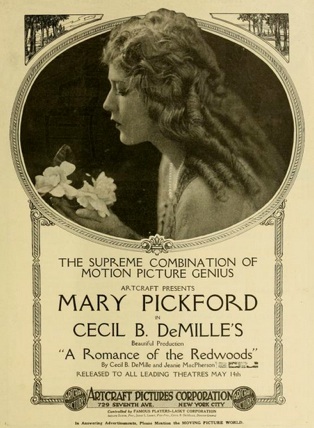
Although Romance of the Redwoods, was one of many films made in Santa Cruz County, it was a rare collaboration between Mary Pickford and Cecil B. DeMille, two of the most recognizable ambassadors of the moving image. The film was made in 1917, at an early period of DeMille’s career that film historians now accept as his most vibrant and effective.
At the time, the influential magnate Adolph Zukor had just initiated the merging of his production company, Famous Players–Lasky, with the smaller subsidiary, Paramount, and was “involved in negotiations to retain the services of his number one box office star, Mary Pickford”. Due to her exorbitant salary demands, which topped $10,000 dollars a week and fifty percent of production profits, Zukor couldn’t distribute her high production costs to small-time theater exhibitors because they couldn’t afford it. Instead a company was created, Artcraft Pictures Corporation, which would release her films directly. Her first two films with the company, Less Than The Dust (John Emerson, 1916) and The Pride of the Clan (Maurice Tourneur, 1917) did not meet studio expectations, so she was paired with DeMille. The famed director did not demand the same recognition at the time that he would later experience. This was due to two things: the fact that silent-era directors were not considered the driving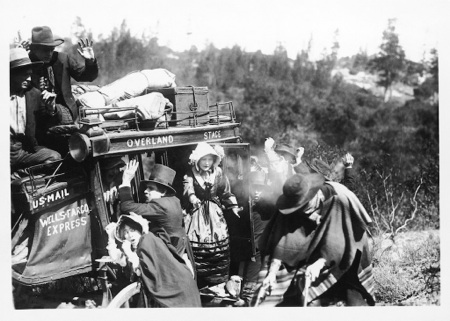 forces behind productions, and the sheer star power of Mary Pickford. Zukor was able to “beef up the star power of the DeMille pictures, helping establish the DeMille name itself as an attraction worthy of Artcraft release”.
Beatriz Michelena and the California Motion Picture Company had initiated Santa Cruz County’s newly designated identity as a prime filming location, and Zukor wanted to capitalize on the atmosphere created by the gold rush. Earle Snell, in his 1918 article Us Folks on the Film: A California Mountain Town that has Gone Stark Movie-Mad, explains the allure of the Bay Area to the Hollywood elite: “When one speaks abstractly of mountain atmosphere he thinks more or less concretely of cliffs and trees and canyons and booming waters. It was something like this that the producers had first in mind when they turned their faces toward the Santa Cruz Mountains--and toward Boulder Creek in particular. They soon learned that the atmosphere has also its human element, the most important and interesting part of it. Call it the human atmosphere as distinguished from the natural”. Although Snell’s poetic prose creates quite the stirring image of Santa Cruz and the San Lorenzo Valley, Zukor’s decision to come to the Bay Area was probably motivated by a combination of creative and financial aspects. The allure of a completely furbished set, such as Poverty Flat, provided the ability to venture right outside the camp and shoot unadulterated wilderness, while retaining the space for interior lighting and staging.
- This advertisement from Moving Picture World displays the importance of Mary Pickford as a star power. You can tell by the placement of her name above DeMille’s, and the larger font.
The outwardly simple screenplay for Romance of the Redwoods, written by DeMille and his longtime collaborator Jeanie MacPherson, became a “subtle and fascinating exploration of human relationships”. Jenny Lawrence (Pickford) is sent to live with her last remaining relative: an uncle who had followed the gold rush to the west for fame and fortune. Black Brown, an outlaw played by the stage actor Elliot Dexter, comes across the dead body of Mr. Lawrence and switches clothes with him, assuming his identity. When Jenny makes her way to Strawberry Flat, a small mining town, she realizes the switch-up and threatens to out Brown as an imposter. However, as she learns more about the rough and tumble town it becomes a decision to either accept Brown’s terms or eke out a hard living in the local dance hall. Jenny accepts the former and the two characters eventually fall in love, with Jenny demanding he change his thieving ways. Brown accepts, but attempts one last stagecoach holdup to raise money for their future. Brown gets caught and is threatened with hanging, but Jenny convinces the Sheriff with a clever ruse involving dolls clothes that she is pregnant with his child. The sheriff insists on marrying the two, and the last sequence holds the couple in a wonderful long shot as they recede into the background, buttressed by a grove of redwoods.
Kevin Brownlow, in his extraordinarily personal Mary Pickford Rediscovered, gives a quick abridged description of the film’s location: “The exteriors were shot in northern California near Boulder Creek, in Santa Cruz County, on sets built by the California Motion Picture Corporation for its productions Salomy Jane (1914) and The Lily of Poverty Flat (1915)” (131). The set that Brownlow is referring to is Poverty Flat, the concept nurtured by Beatriz Michelena and her husband George Middleton. The exteriors are of the town Strawberry Flats. However, the sequence involving the last stagecoach holdup was filmed in an unknown spot in Ben Lomond. The tundra-like environment in the background resembles the partly-forested, partly-limestone landscape of Ben Lomond. A review of the film in Moving Picture World gushes “To begin with, scene after scene is a revelation of the grandeur and beauty of the California Redwoods”.
Although a large portion of the film is contained to Mr. Lawrence’s cabin, the cinematography in both the interiors and exteriors is passionate and understated. It seems that through their collaboration, Pickford and DeMille were pushed to imbue the film with qualities rare to their oeuvre, yet extremely effective. Through the casting of a strong male lead, which tended to lack in her vehicle performances, Pickford was able to extend her emotional range to a higher degree. There was a solid male presence, Elliot Dexter, which she could work off of. Brownlow explains DeMille’s awareness of her tried-and-true system, and how this might have redirected his own process: “…at least DeMille was familiar of her style. He gives her – or was persuaded to give her – a large number of bold close-ups, uncharacteristic of DeMille, and his cameraman Alvin Wyckcoff lit the interiors with more atmosphere than usual”. Vachel Lindsay, an American poet 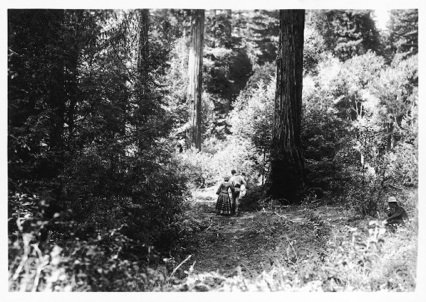 whose legacy has dwindled due to the informal nature of his prose and financial struggles, wrote a complex review of the film for The New Republic. In it he explores the influence of Pickford, and her willingness to push herself to greater creative heights when provided the space: “In the Romance of the Redwoods it begins to appear that the higher the imagination of Mary Pickford’s scenario writer and director, the more sensitive her response”.
All of these elements: the collaboration of DeMille and Pickford, the presence of Santa Cruz County, and the strength of narrative, create a special kind of film. Out of the two that I look at in depth in this website, this was the only one where the film was still remaining. Although the only copy is held at the UCLA Film archive, there is a version, albeit a crude version, on Youtube. It is an excellent example of historical synthesis, where silent film and Santa Cruz’s past both intertwine. It is our duty, as a community invested in the future, to seek the past.