Cecil B. DeMille
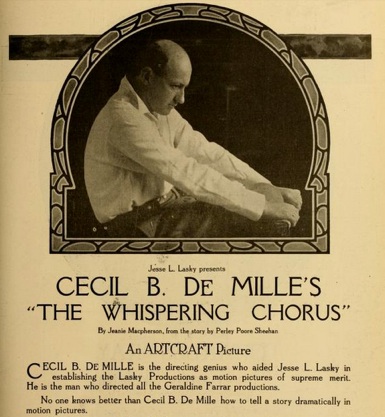
Cecil B. DeMille, one of the most celebrated directors in the history of cinema, was a prime example of Hollywood’s early identity, and helped designate the leader role that directors would take in the future. His films are some of the most recognizable in the industry’s history, allowing Charlton Heston to flourish in such epics as The Ten Commandments (1956) and The Greatest Show on Earth (1952). However, his silent films were just as dynamic and honest, if not more effective in their ability to transition from the stage to the camera.
DeMille actually began as an actor and a playwright, working with David Belasco and Jesse L. Lasky on stage productions. His relationship with Lasky would prove long and prosperous, and they would eventually create Famous Players – Lasky, where DeMille would become director general. Up until 1923 DeMille provided a healthy amount of films for the company, until he started work on The Ten Commandments. Although the film “proved to be one of the most successful films of the silent era, the studio did not renew DeMille’s contract.” DeMille then began his own company for a few years, and then signed a three-picture deal with Metro-Goldwyn-Mayer. The coming of the great depression crippled DeMille’s finances and forced him to stop making pictures for an extended amount of time. He managed to secure a deal with Paramount, his old company that had previously been Famous Players – Lasky, and would end up staying with the company for the rest of his life. His career displays the treacherous nature of the industry, with one of the most prolific directors of all time still having to fight for the films he wanted to make.
- Studio’s began to realize early on, in their hollow quest for the financial bottom-line, that director’s could also draw spectators into the seats. Instead of highlighting the actress or actor on the advertisement, Lasky decided to cash in on DeMille’s rising fame and display an image of the director.
In the beginning of the silent film era, the director took a backseat to the actors and the studio heads, becoming more of just another cog in the complex machine that was the studio system. The industry churned out films, always looking forward to the next project and analyzing the financial overhead. DeMille was one of the pioneers of the director controlling his own projects. Not many made it through the transition from silent to talkie, directors and actors alike. DeMille understood the combination of financial acumen and creative thrust that was required for a successful career as a director. His official website, a priceless resource for any film student or enthusiast interested in his career, gives an apt description of his influence on the role of the director: “DeMille’s celebrity created the prototype of the director as superstar. The actor he had been in his youth never left him and played to the crowds on his sets. Surrounded by a potentate’s entourage, he had dressed in puttee’s and open throat shirts with a flair that became the ubiquitous popular image of a director.”
DeMille also understood, better than any other director before him, the power of the spectacle. His most famous films were worldwide sensations that respected the desires of the fan, the regular Joe who gave DeMille a chance to create the films he wanted to make. In the silent era, when there were very few directors who saw the visual potential of film and could not deviate from the stage, DeMille “gained great attention by focusing on married life rather than on the usual boy-meets-girl formula, and DeMille was able to satisfy his desire to make spectacles by inserting elaborate historical flashback sequences into several of these films.” Much like Alfred Hitchcock, DeMille wanted to cater to the film-going public by combining a deft cinematic touch with a sense of entertainment value. In Moving Picture World, DeMille states in an interview that “What I like about pictures, when comparing them with stage productions, is their bigness, their scope. For instance, where formerly in writing for the stage I would be compelled effectively to describe a thing, now I can show the thing itself.” The film industry would not be the same without the influence of DeMille, and his gifts to the history of cinema cannot be overlooked.