Lily of Poverty Flat
The Lily of Poverty Flat was Beatriz Michelena’s second film for the California Motion Picture studio, after the highly successful Salomy Jane (1914). Although the studio headquarters were located in San Rafael, the company chose to create a western set on the outskirts of Boulder Creek, which would become Poverty Flat. Josephine Clifford McCracken, a journalist and writer active in the Bay area for many years, wrote about the thoroughness of the set in the monthly magazine the Overland West: “And the photo-play, Poverty Flat, is no ephemeral creation of the stage-carpenter, but a solid, log-built village of over two dozen dwellings, stores, offices and salo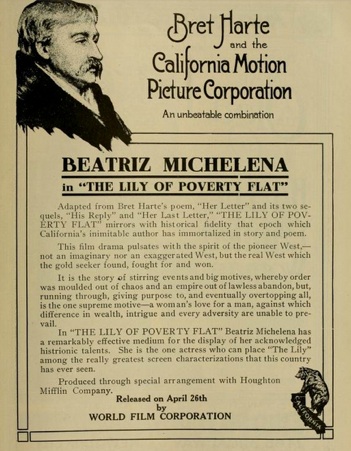 ons – a typical mining camp set up for photo-play scenery at a cost of thousands of dollars.” Although the set was created for this singular film, many films would use the recreation of a western mining town including Romance of the Redwoods. It allowed for location shooting excursions in the Santa Cruz mountains, and then the company could come back to Poverty Flat and shoot interior scenes.
The story, adapted by the screenwriter Charles Kenyon, comes a from a series of poems written by the great writer and journalist Bret Harte, known for his works portraying the pioneering life within early California. McCracken, a contemporary of Harte’s and an admirer, explains her excitement for his work being transferred to the silent screen: “I, for one, a convert to motion pictures, and an enthusiastic one, sincerely hope to see all of the immortal stories of Bret Harte eventually transferred to the screen, where, in picture form, they will delight millions and stimulate thousands at least to familiarize themselves with the work of the man I consider California’s greatest man of letters.” The Harte poems that were adapted were in the form of letters from “Lily” to her lover named “Joe”. Although the letters were light on story and heavy on eloquent prose, Kenyon was able to create a screenplay that resonated with early viewers. While traveling to Poverty Flat from the east coast in search of mining opportunities, Joe meets Lily, the daughter of the camps store. Their relationship blossom after he saves her from a band of Indians, but a problem arises when a gambler with a heart of gold named Hamlin also desires her affections. A jealous ingénue in the camp tells lily that Joe has fallen for an indian maiden, so Lily travels to Paris with her family and Hamlin in tow. While they’re away, Lily’s parents develop a series of debts and Hamlin must gamble to save the family. When they return to Poverty Flat, they find that Joe has run into some trouble with a group of robbers. Hamlin once again comes to his aid but is mortally wounded by the bandit leader, only to make sure that Joe and Lily are finally reunited.
Lynde Denig, an early critic for the Moving Picture World, reviewed the film for the July 1915 issue and her explication reveals how most literary sources celebrated the Boulder Creek location over the story in terms of the film: “In common with other productions of the California Motion Picture Corporation, Lily of Poverty Flat, a five-part picturization of Bret Harte’s poems and story, offers an abundance of beautiful scenes clearly photographed in California. Probably the fine backgrounds provide the most notable element in the film, although there is a plot of fair dramatic quality and the acting of Beatriz Michelena as Lily, Frederick Lewis as Joe and other players in a well balanced cast, is all that the story requires.” At the time motion pictures were not yet considered an artistic rival to the theater, so content was often overlooked. This explains the amazemen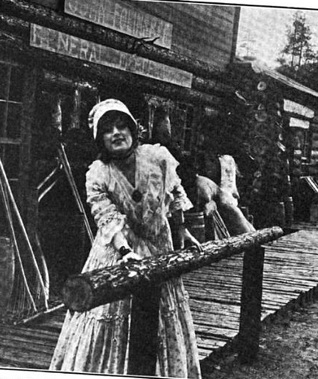 t shown towards the western ruggedness of the Santa Cruz mountains, since location shooting was often overlooked in silent productions. Denig also writes about, quite critically, Michelena’s performance in the film: “…Michelena always appears attractive on the screen and she might further enhance her natural good looks by a more judicious use of make-up. In nearly all of the scenes in this picture her lips are far too heavily rouged, a mistake made particularly obvious by close-ups. This is a small matter, however, in view of the actress’s generally satisfactory portrayal of Bret Harte’s heroine.” Judging from the few other articles I read by Denig, “generally satisfactory” is a gushing recognition of her acting skill.
It’s quite fortuitous that literature and images relevant to Lily of Poverty Flat remain, because the film does not. It would surely be a great opportunity to see the bustling nature of Poverty Flat and the surrounding area come alive in a moving picture, yet the story that we can piece together from the remaining material is tremendous. Instead of the destroyed film reel holding the historian back from exploring the past, it can motivate him further to unlock the surviving elements. This is the legacy that these truncated histories leave behind, the opportunity for a journey into the annals of silent film.