Beatriz Michelena
Beatriz Michelena was one of the first Hispanic actresses to attain stardom in the silent film industry. Her legacy, and its relative anonymity, is a strong example of the silent era’s disintegration of history, which is due in a large way to the fickleness of the standard nitrate reel and the transition between the silent to the talkie. The Women’s Film Pioneer Project, a very useful and insightful collection of biographies online, gives an efficient overview of her short-lived activity within the silent industry: “One of the first Hispanic women to attain stardom in the silent cinema, Beatriz Michelena appeared in at least a dozen films between 1914 and 1920 and headed her own production company, Beatriz Michelena Features, from 1917 to 1920.”
Between 1914 and 1917 she was in contract with the California Motion Picture Studio, which was located in San Rafael. The studio’s utilization of the Bay Area and the San Lorenzo Valley is a large reason these areas became desired locales for industry directors. The company created Poverty Flat for their films Lily of Poverty Flat and Salomy Jane, both of which were filmed in and around Boulder Creek. The fact that her stardom w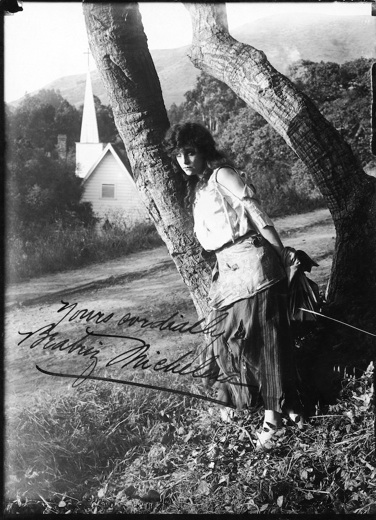 as deeply connected with the Bay Area asserts the areas influential place in film history. She was known for playing a crafty heroine that represented a strength rare in silent film at the time, which was utilized in “westerns that relied on action and emphasized the beauty of the northern California landscape. The variations on the role of the western heroine found in Michelena’s characters are unusual for their time, allowing for an unprecedented fluidity in both ethnic and gender identity”. Much like Mary Pickford, Michelena exhibited an acting style that veered away from the embellishment of stage acting and focused on the subtlety of naturalism. In the October 1915 edition of Moving Picture World, one of the earliest literary industry sources in the silent era, a review of her skill mentions her acute sense of the understated performance: “A noticeable feature of Miss Michelena’s art has always been the care with which she has avoided false and melodramatic effects in her scenes.”
Unfortunately, all but one of her films from the California Motion Picture Studio were destroyed when a group of children, playing with fireworks near their San Rafael studio, lit their storage facility up in flames. This is often the case in the macabre history of the silent era. If her career had been longer than a decade we might have had more sources to choose from, but this also forces the historian to engage even more with the relics in our grasp and embrace the complexity involved with unearthing the past.