Mary Pickford
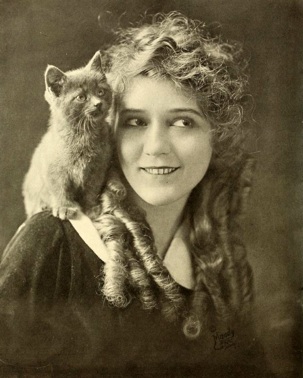
Attempting to designate the importance of Mary Pickford to the history of cinema is an endeavor, considering her desire to keep her films hidden from the public and the frenzy surrounding the transition from the silent film to the talkie. She was the most well known actress of her time, and is considered one of the driving forces in shaping the creative and business aspects of cinema as we know it. Kevin Brownlow, in his revealing tome Mary Pickford Rediscovered, summarizes her importance to film history quite succinctly: “She was a unique symbol of the birth and growth of the only art form that found its origins in the western hemisphere - the motion picture. She was the most popular, powerful, prominent, and influential women in the history if the cinema. Unfortunately, not many people are aware of that fact today”.
Pickford was born in 1892 to a family of actors, and began her long career in show business at the tender age of five, working in any play that her mother could find. After years of touring the states in small productions, Pickford was chosen for a role in David Belasco’s Broadway play The Warrens of Virginia, which also had an unknown actor by the name of Cecil DeMille, who would later direct her in our very own Romance of the Redwoods. Her film career began with the Biograph Company, one of the first companies to devote itself fully to the production of motion pictures. D.W. Griffith, a director for the studio at the time, took a liking to her confidence and skill. This is where she developed her trademark persona and business savvy, and despite “Biograph's secrecy and restrictions, audiences throughout the country began recognizing the girl with the curls and looked for her distinctive work on their local screens without even knowing her name. Thus, with Pickford rests the distinction of having been discovered by the public”. After a short stint with Carl Laemmle’s Independent Moving Pictures Company, she devoted herself to the moving image and joined on with Adolph Zukor’s influential production company Famous Players-Lasky, which would eventually become Paramount Pictures. This is where her popularity skyrocketed and her control over the financial aspects of her career began to take hold. In 1919, she famously co-founded United Artists with Charlie Chaplin, D.W. Griffith and her soon-to-be husband Douglas Fairbanks. This exchange of power would afford her a sense of control that was groundbreaking, especially in terms of an actress, and “from her phenomenal rise grew the concept of the star system”.
Pickford, in her transition between the stage to the screen, quickly understood the artistic capability afforded by film. At a time when cinema was derided as a toy and even production heads such as Zukor did not yet see the full potential of the moving image, Pickford instead saw a medium that was ready for an injection of subtlety and intention. Many say that she was the originator of Stanislavski’s and Strasberg’s idea of the Method, fully encapsulating herself inside her roles by using her turbulent past and lost childhood to engage the character. In Eileen Whitfield’s thorough and imaginative biography Pickford, the author remarks on the difference between the acting of Pickford and the standard, hollow machinations of the stage: “Emotional roles, in those days, meant stage parts in which an actor staggered or collapsed. In movies, Pickford captured the same range, using small, well-chosen movements - biting her lip, perhaps, or fiddling with a shawl”.
Illusory memories and a handful of films are all that remain of Pickford’s legacy, and that is more than most actors from the silent screen are afforded. After her retirement from the screen in 1933, she began her long concealment from the public eye, staying in her famous mansion Pickfair and only allowing the entry of a small group of guests. In 1976 she was awarded a Lifetime Achievement award from the Academy, and the public was rewarded a rare glimpse into her home. This was the last time she was seen in the public eye, and would stay in the confines of Pickfair for the remainder of her celebrated life.
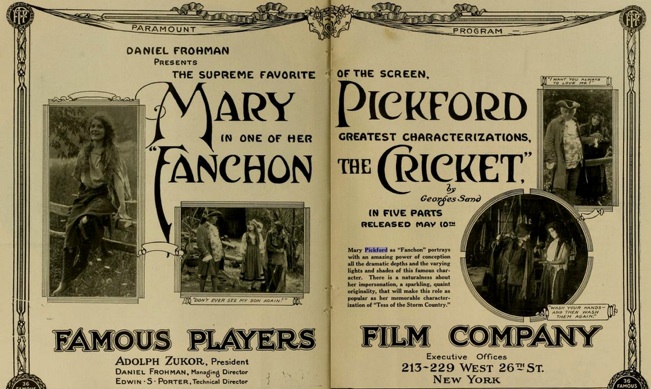
- a typical Pickford advertisement that took up an entire page spread and made sure to display her name above the actual film title