Santa Cruz Locations
Santa Cruz County is checkered with locations that were utilized for filming in the Silent Era. Boulder Creek seems to have been the most popular locale, with the main drag of Highway 9 doubling as a western mining town and the upper end of the San Lorenzo River providing a sense of naturalism. Bonny Doon and Ben Lomond’s striking mixture of barren limestone and tundra forest proved desirable to both Cecil DeMille’s Romance of the Redwoods and the western star Tom Mix, who used the Bonny Doon area for his 1924 film Eyes of the Forest. There are many locations that will never be identified, holding their secrets close. This is the reason that recognizing these sites is important to maintaining Santa Cruz’s collective history.
One of the most important locations was the site of Poverty Flat, the gritty mining town built by George Middleton, Beatriz Michelena, and the California Motion Picture Company. It’s a large reason that filmmaking in the Santa Cruz mountains was seen as palatable to the studio heads in Los Angeles. It was a fully functional set in the heart of Santa Cruz wilderness, which was much more of an untamed space at the time. H.L. Middleton, a businessman who just happened to be George Middleton’s uncle, owned most of the land surrounding Boulder Creek. George was Michelena’s husband and business partner, and they came to H.L. about using his land as a temporary space for what would become Poverty Flat. An article entitled “Big Estate for Picture Purposes” was printed in Moving Picture World at the time and explained the formation of the film set: “It is rugged, densely wooded, marked by lofty crags, precipitous gorges, gulches of Arcadian beauty, meadows and glades rarely visited by man, and giant timber as yet untouched by the woodsman. A whole village has been built for The Lily of Poverty Flat, consisting of 25 log cabins and frame dwellings. This motion picture scenery which, for solid realism and heavy expense, has never been duplicated in the history of photo plays, is an extraordinary replica of the typical gold seekers settlement of the days of ‘49”. Most of the articles I’ve researched state, in one way or another, that the creation of Poverty Flat “had never been duplicated” in the early stages of silent film. The film set may very well have been one of the first fully functioning operations in such a rugged location. This extends its relevance in the grander scheme of film history.
The allure of Poverty Flat to directors was its flexibility as a functioning film set and as a naturalistic location. At this time in film history you had to sacrifice one for the other. A director could decide to shoot on location, but then you would have to shoot interiors in an actual studio. This put financial restrictions on the entire process, so larger film sets and studios were designed to accommodate for this incongruity even though you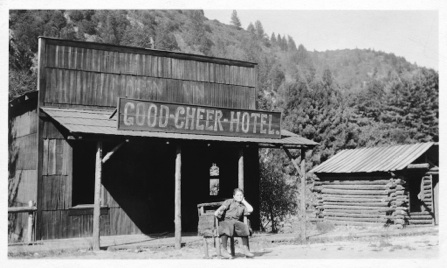 were deprived a sense of realism. Studio heads quickly figured out that if the film-going public was provided enough of what they wanted, in terms of star power and action, sheer verisimilitude could be bypassed. This is a large reason why Hollywood has become the insulated home of the moving image. James P. Leonard, who was a journalist for the now defunct Santa Cruz Daily Surf, wrote an article detailing his visit to the newly minted film set. In it he described the “Methods of Photoing” and how its capabilities offered a cutting edge experience: “An innovation in the art of taking motion pictures has been introduced by the California Motion Picture Company in the staging of this play, which is the taking of interior scenes on the very spot upon which the rest of the acting is being done. To attain this, shells of cabins have been erected minus a roof and one side, over which a huge white sheet is spread for the proper diffusion and regulating of the light. On the floor and sides, out of focus of the cameras, are spread white diffusors and reflectors, in order that every facial expression and the most minute of the interior details may be brought out clearly and vividly.”
It’s difficult to know just how many films were made at Poverty Flat in its short tenure as a production destination. We know that the California Motion Picture Studio used the set for at least four films. In doing research for this project, I have come across people who have shown passion for this aspect of Santa Cruz History. One of those people is Randall Brown; a local historian situated in Felton who has helped me gain insight into the silent film production in Santa Cruz. I had an impromptu interview with him in his office and asked him several questions about Poverty Flat, one of which was about its lifetime and number of films made: “It had two basic periods. It’s established in early 1915. The studio made two more Bret Harte films in that short period of time. You know how fast they made films back then... Rose of the Misty Pool (George Middleton, 1915) was the third or fourth of them, and then they made Phyllis of the Sierras (George Middleton, 1915). They then get out of using it them selves and do more of their work in San Rafael, probably for budgetary reasons. Then, I’m not completely sure, but I think Triangle (studio) started using it. I would need to see The Half-Breed (1916) but I believe they used the set for that film. It was a known good location if you wanted to recreate the gold-rush period. When California Motion Picture Studio started to run into trouble in late 1916, they asked Beatriz to act in Faust without pay and she said no. They still owed her money, so the way that worked out is Michelena and Middleton become the owners of the studio, including the Poverty Flat set. So that’s where Michelena creates her own production house. She becomes a studio head for three pictures worth, Flames of Hellgate (George Middleton, 1920), Just Squaw (George Middleton,1919) and Heart of Juanita (George Middleton,1919)…after her studio disbands, the set falls into disrepair. Thomas Ince then comes to the set in 1922 for the film Soul of the Beast. He revives it for that film and does a remake of Salomy Jane.” From this statement we can assume that there were at least eight films made at Poverty Flat, and many more could have used it for interior shooting or stock footage. It truly is a shame that the set was never identified and marked after films ceased to be made there. Homes were built on most of the assumed area and the landscape has since changed, with trees grown when they were once sprouts and concrete enveloping the curvature of the ground. Poverty Flat’s resonance in our communal history has suffered because of its physical decay, yet its retreat into modern development does not need to completely destroy its memory.
Bonny Doon/ Ben Lomond
Although it did not have quite the filmic history that Poverty Flat had, Bonny Doon played host to at least two films while many more were probably made in the vicinity. The combination of towering redwoods, low-growing chaparral, and beds of limestone create a bleak and melancholy western locale that directors were drawn to. One of the films that utilized the surrounding area was the Tom Mix vehicle “Eyes of the Forest”, for which there are no remaining copies. It is a shame, because the images taken from the Preston Sawyer collection show some great stunts that seemed pretty daring for that era. One image shows an airplane on a wire, with a man riding a motorcycle beneath it. The image is taken at an unknown spot around Bonny Doon. It was a large clearing, highlighted by a barn nestled up against an overlooking hill. Tom Mix supposedly flew an airplane into the side of the barn. The area must have been fortuitous for aviation material, since a lot of the landscape was sand and limestone instead of redwoods.
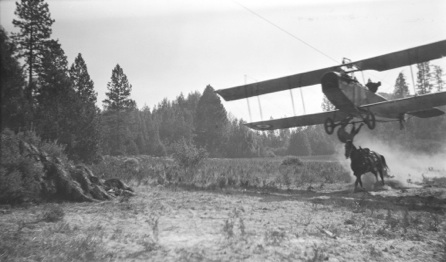
There was an article in the Sentinel Evening News called “Plane Does Thriller Over Bonny Doon, Pilots in Tom Mix Sky Boat Escape in Bad Smash”, that confirmed the films location while detailing the dangerous excitement that surrounded the filming: “Dick Grace, the pilot, and DeVoe, a cameraman, are alive and uninjured today save for a severe shaking up, while the airplane in which the flyers had been zooming over the mountain and woodland region adjacent to Bonny Doon for the purpose of photographing a second plane, also in the air, is almost a total wreck. That there were no fatalities is but one of the unexplained good luck stories of aviation annals. By cool maneuvering, Grace, an expert stunt man, volplaned and fell with the plane and, just missing a tall tree, landed the plane abruptly on the side in a clearing of sandy soil near Bonny Doon. (…) It is believed that production will not be seriously delayed in spite of the fact that the plane wrecked was to have been employed in a smash up several days hence. This is the second instance of fortunate misfortune since the coming of the troupe, the first being the instance in which Tom Mix and his horse, Tony, were injured, but not seriously, by a premature dynamite blast.” His horse Tony was a beloved icon of the early western, and it is said that Mix wanted Tony to receive medical help before him after the incident. If the film still survived, we could pinpoint the area with much more efficiency, yet the images do provide a compelling view of the area around the turn of the century.
Ben Lomond also played a small role in the history of silent film in Santa Cruz County. In Romance of the Redwoods, the climactic stagecoach holdup that brings the law down upon Black Brown is filmed on a dusty side-road with redwoods covering the landscape. This was filmed somewhere on the outskirts of the Ben Lomond area. Although it is extremely difficult to pinpoint the exact location due to an ever-changing environment, historical accounts place the scene within this general location. The images that remain show the stagecoach traveling down a winding dirt road, with scattered trees and rolling hills jutting up in the background. DeMille must have appreciated the gravitas hidden within the rugged scenery, and employed the topography throughout the film.
Pogonip
Pogonip was an integral part of Santa Cruz’s filmic past, yet in a slightly different manner. Pogonip was once a thriving country club and polo field earlier in the century. Ross Gibson, a noted local historian who was instrumental in revitalizing the history of the downtown area after the Loma Prieta earthquake, wrote an article about Pogonip for the San Jose Mercury News in 1995, detailing its rich history: “Pogonip, once named among the nation's top scenic golf courses, also had polo grounds that headquartered the first United States Women's Polo Association. The club attracted international sports figures and was popular with Hollywood personalities such as Darryl Zanuck, Spencer Tracy, Roy and Walt Disney and Mary Pickford.” The sprawling field was also utilized by the William fox production Thunder Mountain, which happened to include Zasu Pitts, the famed Santa Cruz product who displayed a sense of comedy rare to the silent actress. Pogonip  enjoyed its high-class stature for over twenty years. However, when “Marion Hollins established her Pasatiempo course nearby, the club could not compete, and closed in 1935.”
Since then, Pogonip has experienced scattered rehabilitation efforts that wither after a short period of time. After many failed attempts, its “614 acres became city property in 1989. A lease obliged the club to repair or rebuild the clubhouse, which would remain private for 28 years and revert to the city in 2020. But the club's drive to sell 200 $5,000 memberships, with $80-a-month dues, netted only one membership. This and declining membership forced the club to close in 1993, leaving the city ill - equipped to restore it.” It has become another spot fallen into disrepair. Recognizing this framework of past narratives should be an integral aspect of our community, and respecting these physical landmarks bolsters the memory itself.


- The Poverty Flat set, with the general store sitting in the middle