Research

Over the years, the Strome Lab investigated how cells in metazoans are instructed to develop as germ cells and how their germline fate is protected. Germ cells have a special mission, to produce gametes and entire new organisms generation after generation. Using C. elegans as a model, we showed that during embryogenesis, the chromatin regulators MES-2/MES-3/MES-6 (the worm version of PRC2) and MES-4 epigenetically transmit a memory of germline marking of chromatin from parental germ cells to germ cells in offspring. Without this memory and its impact on silencing the X chromosomes in the offspring primordial germ cells, those cells die. The MES proteins also promote germline development of somatic cells, but another set of chromatin regulators including the DRM complex antagonizes germline fate in the soma. As germ cells develop, perinuclear “germ granules” protect germline fate by antagonizing somatic fates. Our findings have elucidated how chromatin regulators and germ-granule factors launch germ cell development and prevent soma-toward-germ and germ-toward-soma transformations. Below is a brief history of the Strome Lab journey.
C. elegans germ granules
Germ granules are germline-specific ribonucleoprotein assemblies that are conserved among diverse species. They were initially observed by electron microscopy. As a postdoctoral fellow, I discovered the first antibodies to germ granules, called P granules in C. elegans. Having antibodies enabled me and later my lab to elucidate the segregation, composition, properties, and function of P granules. Maternally provided P granules are progressively concentrated in the germline blastomeres during the early divisions of the embryo. They are composed of constitutive proteins, including the PGL and GLH families of proteins, and many stage-specific proteins and RNAs. In germ cells, P granules overlie the majority of nuclear pores, where they have similar properties to the insides of nuclear pores and extend the nuclear pore complex environment, providing a specialized cytoplasmic compartment in germ cells. P-granule mutants display maternal-effect sterility, which we initially expected to be due to failure of germ cell specification. However, our analysis of worms simultaneously depleted of four critical P-granule components showed that worms successfully launched germline development but at later stages displayed reprogramming of germ cells toward neurons and muscle. Thus, P granules protect germline fate and totipotency by preventing somatic development.
C. elegans MES proteins
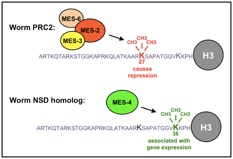
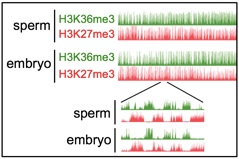
To identify C. elegans genes whose products must be maternally provided to offspring for the offspring’s germline to develop, the Strome Lab carried out forward-genetic screens for maternal-effect sterile (mes) mutants. We identified four mes genes, which encode chromatin regulators that must be maternally supplied to offspring for the nascent germline to survive. MES-2, MES-3, and MES-6 form the worm version of Polycomb Repressive Complex 2 (PRC2) and methylate histone H3 on Lys 27 (H3K27me), a modification that represses gene expression. MES-4 is a homolog of the mammalian NSD proteins and methylates H3K36, a modification generally associated with active gene expression. Both MES-4 and H3K36me display dramatic concentration on the autosomes and absence from the X chromosomes. These findings suggested that to survive and develop, primordial germ cells must inherit proper marking of the genome by MES-2/3/6 (PRC2) and MES-4. Indeed, in embryos MES-4 and H3K36me are concentrated on genes expressed in the maternal germline and PRC2-catalyzed H3K27me is concentrated on genes that are kept silent in the maternal germline, including somatic genes and genes on the X chromosome.
Passage of an epigenetic memory of repression: Through a combined genetic and imaging approach, we demonstrated that both the sperm and the oocyte transmit H3K27me-marked chromosomes to the embryo, and that in the absence of PRC2 in the embryo those marks are faithfully passed to daughter chromatids through a few rounds of DNA replication before they are diluted to below detection; in the presence of PRC2 in the embryo, those marks are faithfully passed to daughter chromatids through many rounds of cell division. These findings show how epigenetic memory, in our case an epigenetic memory of repression in the germline, can be transmitted across generations and through cell divisions. We recently showed that in offspring that inherited the sperm genome completely lacking repressive H3K27me: 1) different tissues (both soma and germline) up-regulated genes specifically from sperm alleles, 2) different tissues up-regulated different sets of genes, revealing the importance of tissue context, 3) in the germline, up-regulated genes retained the inherited H3K27me(-) state and were enriched for neuronal genes, while genes not up-regulated regained H3K27me, and 4) those offspring transmitted the inherited H3K27me(-) state and the resulting up-regulated state of sperm alleles to the next generation, so transgenerationally. Thus, sperm-inherited H3K27me marking influences transcription and cell identity in the germ cells of offspring and grandoffspring.
The X-chromosome focus of MES regulation: We finally figured out why the primordial germ cells (PGCs) in young larvae from mothers lacking PRC2 or MES-4 die. By hand dissecting PGCs from mutant larvae and performing RNA-sequencing analysis of single pairs of sister PGCs, we learned that they dramatically upregulate genes on the X chromosome. We further demonstrated that overexpression of genes on the X is the cause of PGC death. Thus, maternal PRC2 and MES-4 cooperate to protect germline survival by preventing synthesis of germline-toxic products encoded by genes on the X chromosome,